Sunday, 31 January 2016

Cultural Appropriation


When I went back to Cameroon last year for the Christmas holidays I noticed a lot of women wearing sarees and churidars. My immediate reaction (in my head of course) was “hmm na so Indian dem di cam take over pays, anyhow ie fine. Na wa own diversity be this”. Then one day I came across a group of women, still in Cameroon, gossiping about some Indian guy and “that their mop dem way di so so smell like garlic”. This really pissed me off and got me seriously thinking about cultural appropriation. So some of us Cameroonians think it is fashionable to wear sarees while stereotyping Indians for having bad breath.


I noticed that there are many examples in the west of white stars adopting certain aspects of black culture as cool and fashionable while failing to speak out on critical issues of white on black racism. Or everyday Britons wanting to go eat some authentic Caribbean food while making sure that the restaurant in question is not in a “shady” neighbourhood. Obviously there's nothing wrong with a white person wanting to enjoy proper jerk chicken or having their hair done in cornrows. But what does it say about that person if they don't want to go to or be seen in a neighbourhood which has predominantly black people in it; or if they go ahead and call black women “nappy headed hoes”?


Let's go ahead and consider these two examples: One, a teenage girl born to a Native American chief is kidnapped and forced to marry an Englishman. She is then taken to England and used as an icon to encourage the oppression of Native Americans by the English. Two, another teenage girl born to German Jews. Went into hiding with her family due to Hitler's oppression of Jews and wrote a diary that eventually became one of the most widely read books of our time.


Now these two young women have had deeply traumatic lives. However Walt Disney has warped and romanticised the story of pocahontas into a money making fairytale with a happy ending. Can we imagine what would happen if the same was done with Anne Frank's story, maybe depicting her as some Jewish girl who eloped and lived happily ever after with a Nazi officer?


Question is, where do we draw the line between cultural appreciation and appropriation? When does it become offensive for someone to adopt aspects of a culture that isn't theirs?


Tuesday, 9 September 2014

Americanah


Sourcehttps://www.goodreads.com/book/show/20939941-americanah

The first book i read from this author was 'Half of a Yellow Sun' and I absolutely loved it.

Unlike Half of a Yellow Sun, Chimamanda's Americanah is actually a love story. I was engrossed from the start with the story of Ifemelu's life in America and what she was ready to leave behind when she decided to move back to Nigeria. Most of us being in her shoes wouldn't have the courage to give up all that. I was so caught up in her love story with Obinze and their blind conviction that they would make it work when she moved to America. They had a plan and it would work! Well, haven't we all been there?

What makes this book special is the fact that it doesn't only concentrate on the two protagonists. There are other characters whose stories have been well developed and provide a deeper context with which to draw in the reader. It also gives a near-accurate description of the way race is perceived by most people in Nigeria, UK and USA.

I really loved Obinze's character and how he ironically got married to a woman whose qualities matched those of a girl he had previously refused to date back in high school. However the story of his life abroad almost brought tears to my eyes. It was heartbreaking and yet reflects how so many people struggle when they travel abroad to find a better life.

I was also intrigued by how Ifemelu dealt with race-related issues when she was abroad. She seemed so vocal at times, speaking her mind without restraint. However in other occasions she just holds back and decides to keep quiet about things that she clearly finds offensive.

Overall this book was wonderful and endearing. I would highly recommend.


Friday, 15 August 2014

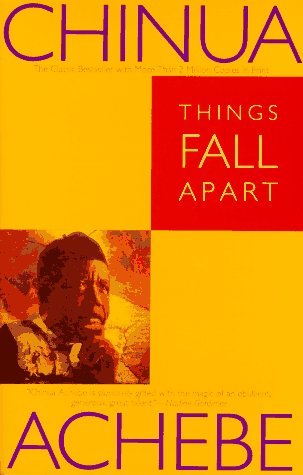
Things Fall Apart


Sourcehttps://www.goodreads.com/book/show/37781.Things_Fall_Apart

Just finished reading this book by Chinua Achebe and I must admit it struck a chord.

I had actually read the simplified edition when I was younger and recently came across a really negative review of the book on goodreads website. This review prompted me to read the book again just to see things from the reviewer's point of view and I must say it felt like we both read two completely different books.

The story of Okonkwo the great warrior and how he fell from grace is such a compelling tragedy. In part one Achebe does a really good job of portraying the nature and practices of the Igbo tribes. Personally their practices seemed really extreme but I like the fact that he neither showers them with praise nor criticism. He simply states them as they are.

It is clear that Okonkwo has a lot of daddy issues. As a result he is very determined not to allow his father's short comings to ruin his life. Unfortunately arrogance is another vice that contributes greatly to his downfall. I especially like the parable of the tortoise attending a party in the sky which teaches a very good lesson about inter-personal relationships.

Things really begin to fall apart when the British missionaries come to spread the gospel in the surrounding villages. I believe that if the foreigners had stopped at spreading the word a lot of the ensuing conflict could have been averted. Unfortunately this was one of the ploys of colonialism / imperialism in which they used their religion to gain ground and confidence within the tribes and then started imposing their statutes and governance on the local people.

The fact that some of the clans men weren't united to a common cause also contributed to their downfall. This can be seen in the situation where the court messengers (local people working for the white people) disrespected their own elders who where held in custody and collected bribes from the villagers in addition to the initial fine required to release the elders.

Conclusion: Overall a very good read, I would highly recommend.


Wednesday, 27 November 2013

Makaraba


Sourcehttp://www.aphroden.com/the-makaraba-an-artistic-form-of-african-expression/

Comment: This is an interesting article from the writers at Aphroden.
Before now I never knew what those hats were called.
Talk less of what they mean 'scrape'!
Visit the link for more details on this story

Saturday, 23 November 2013

Muammar al-Gaddafi


Source: Je wanda magazine

Il n’était peut-être pas noir, mais il était la preuve que l’africanité n’a rien à voir avec la couleur de peau. De la gandoura au boubou en passant par la thoab bédouine, Kadhafi portait chaque fois qu’il le pouvait, son amour pour l’Afrique